
How to Build an Overseas Patient Contact Point for Medical Tourism


When does a medical tourism brand need a contact point abroad?
A Health Tourism provider needs a contact point abroad when its central team cannot solve a proven access problem. Start with the problem, not the address. A local office is one option; a team that works in the patient’s language and time zone may also help.
The contact point discussed here is not a clinic. It helps people ask their first questions, learn how to send records and find the team responsible for their next step. It must not act as a second source of medical advice or promise that a treatment will suit someone.
Look for repeated gaps in the current service. Are patients waiting too long for a useful reply? Do they have to tell the same story to several staff members? Are they unsure whether the person discussing costs is also making a clinical decision?
These gaps need different fixes. A long wait after office hours may call for a new shift, not a new lease. Repeated requests for the same records may point to a poor handoff between teams. Local presence will not fix a process that remains unclear.
The World Health Organization’s Patient Safety Rights Charter sets out rights in safe care. Published on 16 April 2024, it does not prescribe an office or sales model. Our practical reading is that a first contact should clarify the path to care without implying clinical powers it does not have.
FL’s resource on health tourism across several communication channels discusses moving beyond a single channel. Apply that idea to the first patient conversation: the website, phone team and local desk should explain the same role. Patients should not hear a new version of the service each time they switch channels.
How should a local office, facilitator and central team be compared?
Compare each model against the access gap it can solve, its scope and the cost of running it safely. A clear address can help people find a team. It does not prove that the team gives sound answers or can provide care there.
| Model | Best-fit need | Main strength | First check |
|---|---|---|---|
| Central digital team | A small set of markets | One record and close oversight | Can it cover local language and hours? |
| Authorised facilitator | Travel and local support | A local network | Are its powers and contract clear? |
| Local office | Steady demand for face-to-face talks | A nearby point of contact | Is its non-clinical role clear? |
| Mixed model | Local access plus central support | Shared work across both teams | Who owns each open question? |
Test a central team first if it can cover the language and working hours patients need. Keep enquiries in one secure record and set a clear route to clinical staff. Ask why people still want an in-person meeting before treating that wish as a reason to open an office.
For example, imagine a patient in the UK who can only call after work. The team in Türkiye has already closed for the day. A trial evening shift would test whether hours, rather than distance, are the real barrier.
A facilitator is a separate organisation that may help with travel, stays or language support under its agreed scope. Begin with Türkiye’s Ministry of Health lists of authorised facilities and facilitators. Match the legal name to the contract and record when you checked it.
That list is not a complete quality check. Review the service contract, data roles and rules in the target country with the right experts. Staff must explain whose behalf they act on, rather than speaking as though every company is the hospital itself.
Choose an office only when the need for local meetings is clear and steady. Signs, staff titles and web copy should state what happens there. If no clinical care is provided, neither the word clinic nor a vague promise of local treatment should suggest otherwise.
What belongs in the contact point’s trust file?
The trust file should contain the facts, approved answers and role limits that staff need for a safe first conversation. Think of it as a working reference, not a sales deck. Give each part an owner and a review date.
For Türkiye, consult the Ministry of Health’s regulation page dated 26 April 2025 and check the provider’s current authority. Separate legal advice is needed for an office abroad, local promotion and data transfers. This guide offers a way to plan communications, not a ruling on whether a proposed setup is lawful.
Prepare these records before staff start taking enquiries:
- Identity: the legal name and role of the care provider, local contact point and any facilitator, with a source for each check.
- Scope: questions local staff may answer and medical questions they must pass to the clinical team.
- Reply plan: languages, working hours, response goals and the person who takes over if a reply is late.
- Price control: who approves a quote, what it includes, extra costs, its expiry date and how changes are shared.
- Data route: why each record is needed, where it goes, who can see it and who sets the storage period.
- Correction log: one named owner who updates old answers across teams, partners, websites and languages.
The privacy notice must describe the real process. Türkiye’s KVKK guidance on the duty to inform people about data use lists the facts to provide when data is collected. These include the controller’s identity, purpose, possible recipients, collection method, legal basis and the person’s rights.
A controller is the party that decides why and how personal data is used. Do not assume that the hospital, local office and facilitator all share that role. Ask the legal team to map the actual roles and reflect them in the notice.
As a process rule, request only what is needed for the next defined step. Someone asking about office hours does not need to send a full health file to get an answer. If they then ask for a clinical review, explain the approved route for sending the records that team needs.
Keep the first enquiry distinct from the medical record. A handoff note should state the open question, its owner, when it was passed on and when a reply is due. This note tracks the task; it does not replace a clinical record or allow local staff to interpret it.
What should happen during the first 90 days?
Use the first 90 days to test one clear problem before committing to a larger operation. This is a proposed pilot plan, not a legal deadline or an industry rule. The launch announcement should follow the service design.
During days 1–30, review six to twelve months of enquiries from the target market. Sort them by language, time, repeated questions, missing records and points where contact stopped. You might start with 30 conversations, but that number alone does not make the sample representative of a whole market.
Remove names and health details that are not needed for this review. Define the problem in plain terms and record the starting position. For example, the trial might test whether an evening shift reduces unanswered questions after UK working hours.
During days 31–60, test one model within one service line. Prepare the role card, privacy notice, answer file, secure records route and approved quote. Run through a delayed reply as well as a smooth enquiry, so staff know who takes over when the normal plan fails.
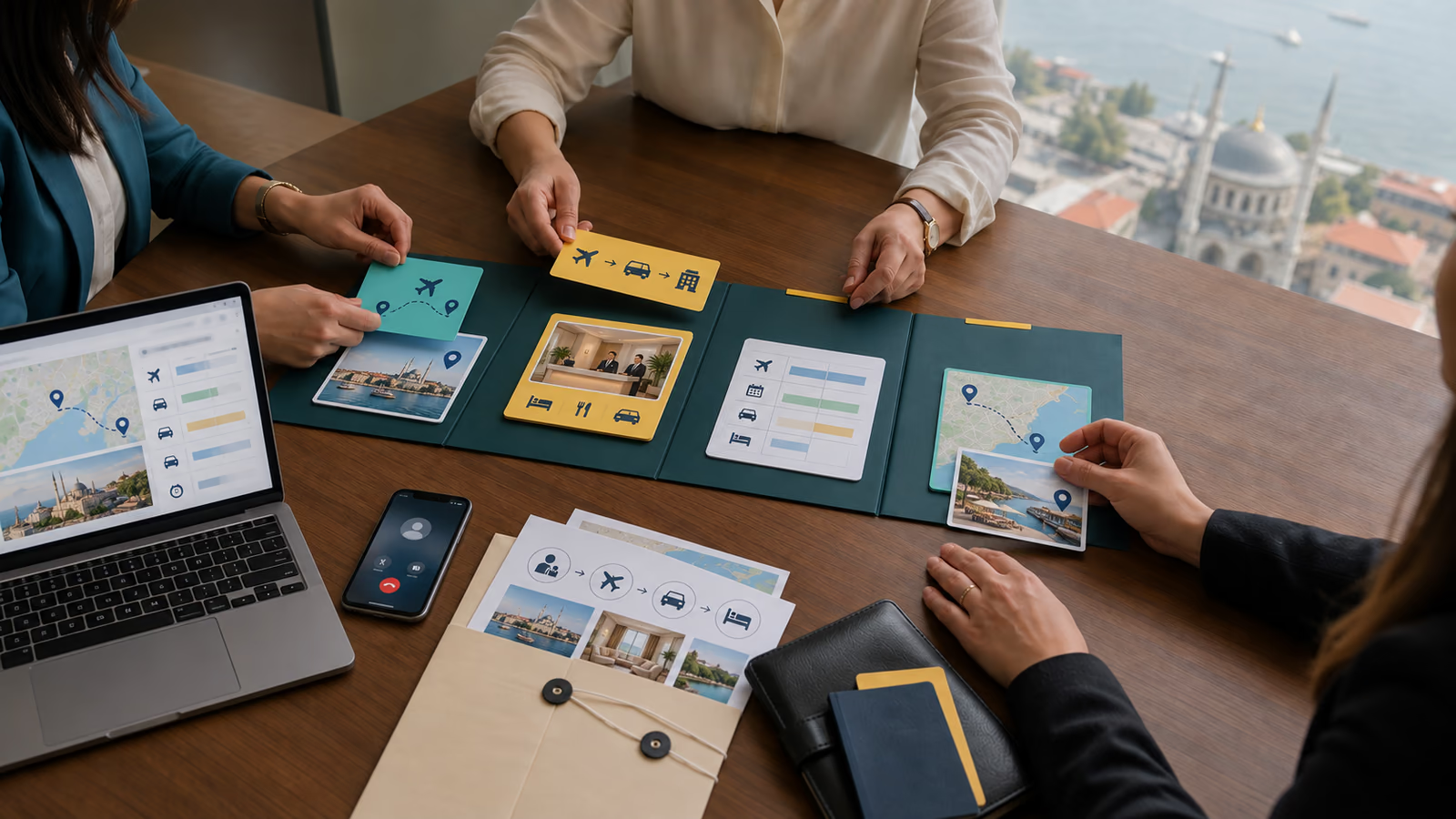
During days 61–90, decide whether the trial solved the defined problem. More messages are not enough. Use these checks together:
- After two contacts, can patients explain who they spoke to and what happens next?
- Do staff pass medical questions to the right team without giving their own treatment advice?
- Do records stay in approved systems rather than personal accounts?
- Have repeat calls and complaints about conflicting answers fallen from the starting level?
- Do the local, clinical and communications teams use the same current answer file?
Evidence: The Standard’s account of Acibadem London Office describes a non-clinical starting point where people can discuss costs, timing and possible care routes. The page is dated 25 June 2026 and marked as sponsored content. It is not independent earned coverage or proof of patient outcomes.
FL’s Acıbadem strategic communications case record describes a separate approach: bringing medical experts into international health media. It is the agency’s own account, not evidence that it set up or proved the success of the London Office. Keep those claims separate when using the two examples.
FL’s healthcare case study with different target-market approaches also separates its market narratives. The useful planning lesson here is to test local needs before copying a format. No case cited here proves that an office will bring more patients to another provider.
How should trust and communications performance be measured?
Measure whether people reach the right team with a clear next step, not just how many forms arrive. Keep volume, trust and business results in separate parts of the report. A large inbox can hide long waits and poor answers.
Track time to a useful first reply rather than an automatic receipt. Count open questions, repeated transfers and files held up by missing records. Compare the same scope before and during the trial; do not mix a new service with an old one and claim improvement.
Ask patients to describe the next step in their own words. Check how often staff have to explain the same price scope again. Review whether one person owns a complaint through to closure, even when several teams help resolve it.
Classify media work as earned, sponsored or distributed. Earned coverage means an independent editorial decision; a paid feature and a republished release are different outputs. A story that wrongly calls the office a clinic needs correction even if it brings traffic.
At the final review, keep the model, expand it against a proven need or stop the pilot. Each new city, shift or office should solve a named problem. A forecast of media reach or a promise of patient volume is not enough to justify the spend.
Frequently Asked Questions
These answers clarify role limits and the first checks for an overseas patient contact model.
Does every medical tourism brand need an overseas office?
No. First identify the problem the central team cannot solve. If there is no clear need for local meetings, a secure digital team with suitable language and working hours may be enough.
May the contact point recommend a treatment?
Not within the non-clinical model described here. Staff explain the process and the secure records route, then pass medical questions to the authorised clinical team.
What should be checked before appointing a facilitator?
Start with current authority and the exact legal name. Review the contract, scope, data roles and complaint route. Have the rules in the target country checked separately.
What is the strongest sign that the contact point is working?
Patients know who is handling their question and what comes next. Look for that clarity alongside fewer repeat contacts, fewer conflicting answers and clear ownership of open tasks.