
O-1B Press Files: How to Summarize a Mixed Review Fairly


A mixed review needs a summary that preserves its judgement
A fair summary of a mixed review keeps the praise, the limits and the critic's overall judgement in view. It should help another reader understand the source without opening every page first. It should also make the full source easy to check. A short line that turns a qualified verdict into blanket praise fails that task.
This guide concerns press files for O-1B Arts, the US visa category for people with extraordinary ability in the arts. The file may contain an exhibition review, a theatre review or a long assessment of several works. Some passages may praise the artist while others challenge the same choices. The team's task is to describe that record accurately before anyone assesses its legal use.
The USCIS guidance for O-1B Arts discusses published reviews within a criterion concerning recognition for achievements. A negative or mixed review does not automatically satisfy that criterion. Nor does a favourable quote establish eligibility. A qualified immigration lawyer must assess the material and the complete case.
The method below is an editorial check, not an immigration test or a filing rule. It applies to your working summary and any proposed excerpt. It does not tell you which documents a petition must contain. Keep those decisions separate from the basic question: does the summary still say what the critic said?
Read the verdict before selecting the most useful sentence
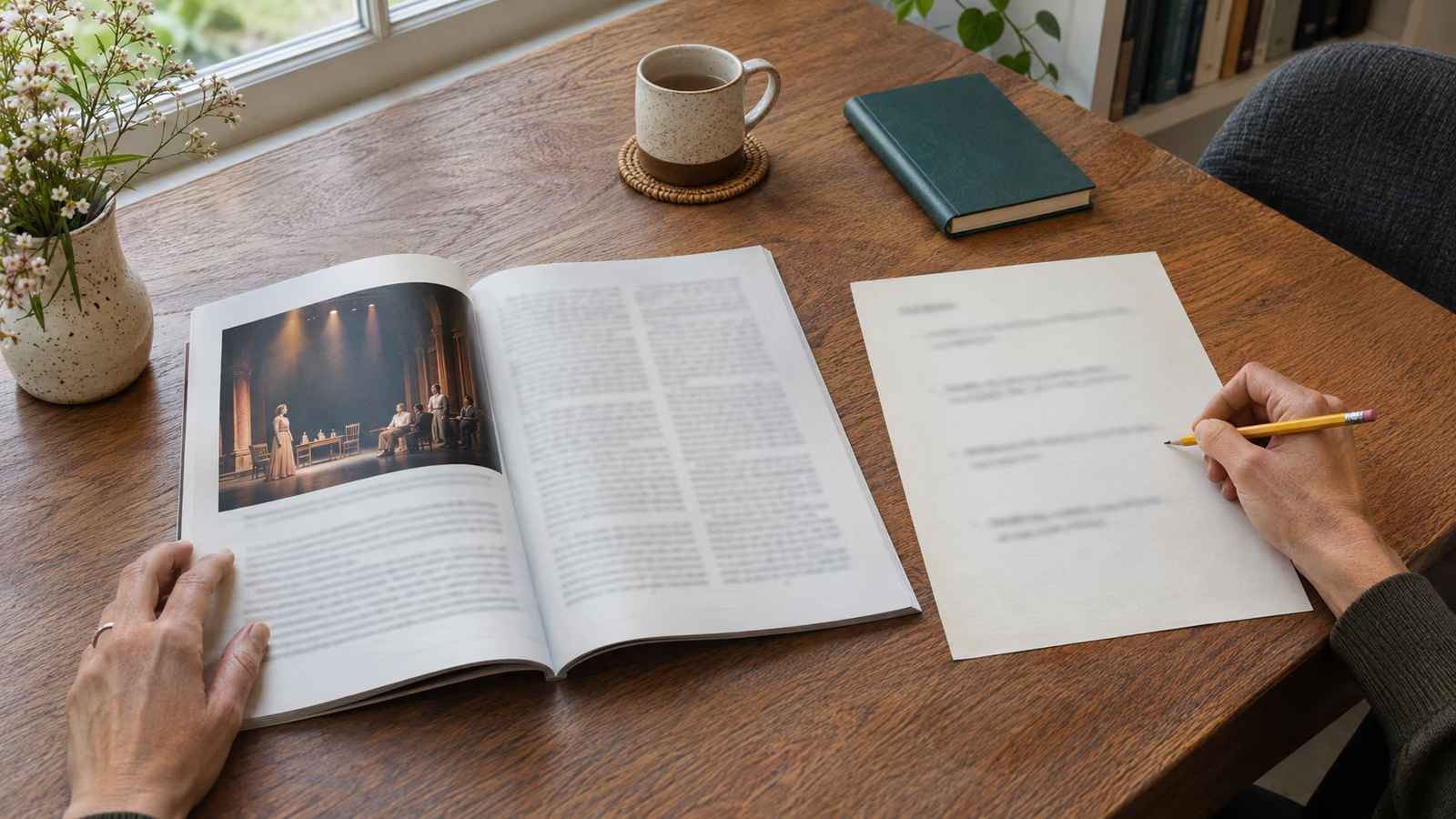
Start with the complete review and identify its main judgement before selecting a quote. Reading only the highlighted line can hide a change of direction later in the text. Headlines, introductory paragraphs and closing passages may also frame an apparently positive sentence. Read them together, then write a plain account of the review's position.
Use a short working note with four fields: what was reviewed, what was praised, what was criticised and what remains unclear. This is a practical reading aid, not a score. There is no need to assign the article a percentage of positive coverage. A count of approving words cannot explain what those words mean.
- Object: Identify the work, performance or artistic choice that the critic discusses.
- Praise: Record the specific strength described, including any limits attached to it.
- Criticism: Record the concern and whether it affects the same strength or a different aspect.
- Uncertainty: Flag irony, unclear references or a passage that needs a second reading.
Check the proposed summary against that working note before sharing it. Can a new reader tell which parts of the review were favourable and which were not? The source should remain recognisable after it has been shortened. Your note should not sound more certain or more enthusiastic than the review.
Do not confuse the critic's opinion with a factual error. You can dislike a judgement and still report it accurately. A wrong date or name is a different issue that may warrant a factual correction request. Keep any such request separate from your response to the review's tone.
Choose between a direct quote and a clear paraphrase
Use a direct quote only when the chosen words retain their meaning without hidden qualifications. A paraphrase is your own account of the source, clearly presented without quotation marks. It often works better when praise and criticism appear in different paragraphs. Either form needs a visible route back to the original.
Consider this invented example: “The final scene is moving, but the long opening makes its arrival feel overdue.” Quoting only “The final scene is moving” presents a narrower point. Calling the review “an enthusiastic endorsement of the production” goes much further than the source. A fair summary would mention the moving ending and the criticism of the opening.
The Associated Press guidance on telling the story requires accurate quotations and their proper context. It also warns against using omissions to change meaning. Those standards offer a useful check on a proposed excerpt. An ellipsis shows that words are missing; it does not make every cut fair.
- Keep words such as “but”, “although”, “only” and “not” when they control the meaning.
- Do not join distant fragments into a sentence the critic never wrote.
- Keep quotation marks for exact source wording; label your own account as a summary.
- Check whether the selected passage represents the judgement you attribute to the review.
Sometimes the cleanest choice is to avoid a pull quote altogether. Write two short sentences that capture the praise and its limit. Leave the exact wording available in the source record. The goal is a useful account, not the strongest possible promotional line.
Keep tone and meaning intact across languages and formats
A translated summary should preserve the strength and tone of the original judgement. A modest compliment should remain modest. A cautious observation should not become a firm claim. When irony is uncertain, flag it for review instead of choosing the most flattering reading.
In another invented example, a critic describes a work as “ambitious, if not always convincing”. A translation that keeps only the ambition loses the doubt. A summary that calls the work “universally acclaimed” invents both a verdict and a wider audience. Neither change is justified by making the sentence shorter.
Reuters' standards on quotation and context stress representative selection and care with translated tone. Treat this as an editorial principle, not a USCIS rule. Ask a fluent reviewer to compare the original passage with the translated version. The reviewer should see the surrounding paragraph, not just the proposed quote.
International communication needs more than accurate vocabulary. Our guide to adapting public relations (PR) for international markets explains why reader expectations differ. That adaptation should shape how you explain a source. It should not change what the source says.
The same discipline applies when a longer summary becomes a website caption or a social post. A headline may have less room, but it still needs a fair scope. If the necessary qualification cannot fit, use a neutral description and link to the full account. Recheck each format after the text has been shortened.
Repair a misleading summary without rewriting the review
Repair the summary by changing your own claim and showing the source's relevant limits. Do not ask the critic to turn an independent judgement into promotional copy. If the source contains a factual mistake, address that separately with clear evidence. Your internal note should distinguish an error from an opinion you wish had been different.
Imagine a fictional review that praises the lighting but finds the dialogue weak. The team's draft says, “The critic praised the entire performance.” Replace that with, “The review praised the lighting and criticised the dialogue.” The second version is less flattering, but it accurately describes the article.
Another invented draft calls a review “negative” because its last paragraph raises a concern. Earlier passages may contain substantial praise. Read the complete text before replacing one distortion with another. A balanced summary should preserve the actual pattern, including a judgement that resists a simple positive or negative label.
Give a second editor the source and the proposed summary without telling them which sentence the team hopes to keep. Ask what they believe the critic's overall position is. Compare their reading with yours, then revisit any gap. This is a practical cross-check, not a vote on whether the review helps a legal case.
Keep the original summary and the corrected version in the working record. Note what changed and why, using plain language such as “restored omitted qualification”. If a misleading version has already appeared on your own website or social account, correct that version too. Use a shared PR and search engine optimization (SEO) content plan to track those changes across your own channels.
Send a clear editorial record for legal review
Send the full source, the proposed summary and any unresolved question together for legal review. The lawyer should be able to see where the team's description ends and the critic's wording begins. Do not hide a material qualification in a separate note while presenting only praise in the main summary. Make the relevant context easy to find.
- Include the source title, author, publication date and working link.
- Label exact quotations, translations and team-written summaries separately.
- Identify the passage that limits or changes the meaning of the selected quote.
- State any unresolved issue and who will check it.
Keeping a complete internal record does not mean every reviewed item must be filed. The legal adviser decides how the evidence should be handled. The communications team should provide an accurate basis for that decision. It should neither promise approval nor describe a criticism as proof of recognition without a proper assessment.
For wider reuse, connect source checks with your international PR and search content process. Keep the approved meaning consistent across languages and channels. Accurate source treatment comes before a more visible headline.
Frequently Asked Questions
These answers explain how to preserve meaning when preparing a mixed review for a press file.
Can a mixed review support an O-1B Arts petition?
Its legal relevance depends on the content and the wider case. A communications summary cannot determine that. Give a qualified immigration lawyer the complete review and an accurate account of its praise and criticism.
Can we quote only the positive sentence?
Only if the excerpt and the claim around it remain fair to the source. If a nearby qualification changes its meaning, keep that context or use a balanced paraphrase. A link alone does not repair a misleading claim.
Should we remove a negative review from our working record?
Keep an accurate internal record of what the team reviewed, including concerns and revisions. That record supports informed advice. Which material belongs in a petition is a separate legal decision.
What if the critic uses irony that is hard to translate?
Ask a fluent reviewer to read the full passage and flag any uncertainty. Do not turn an unclear phrase into confident praise. Keep the original wording available beside the proposed translation.