
How to Prepare a Clinical Spokesperson for International Media
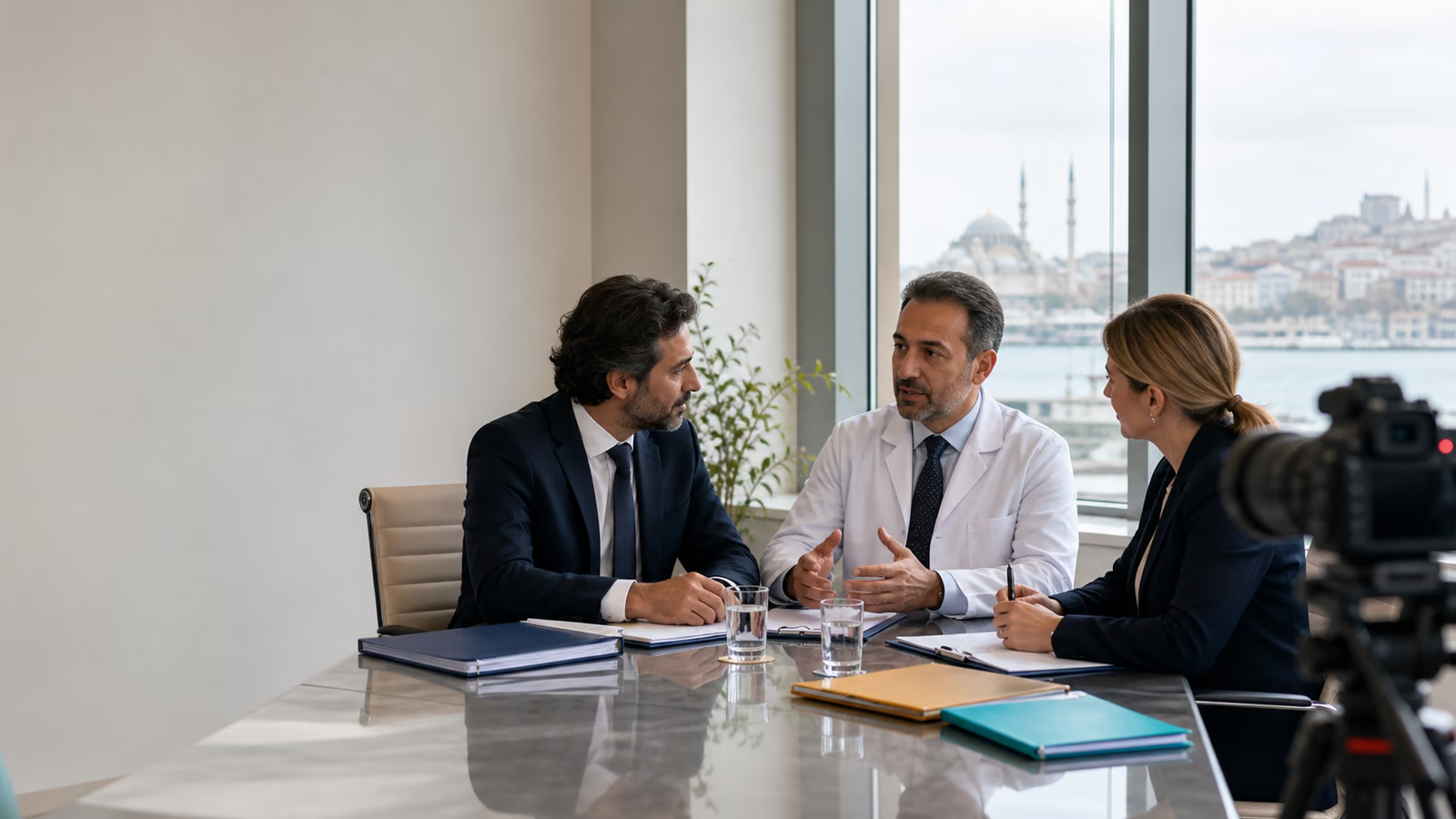

What should clinical spokesperson preparation achieve?
Health Tourism spokesperson preparation should help a physician explain verified expertise to an international audience without turning clinical authority into a promotional guarantee. The aim is not to script every sentence. It is to give the expert a current evidence base, a clear remit, a realistic sense of the audience and a safe way to state uncertainty.
A reporter may ask why international patients consider Türkiye, what a new study means, or whether a procedure is becoming more common. Those questions contain several possible stories. The physician can explain a clinical concept within their field, but should not be asked to validate a market-size figure they have not seen, promise an individual outcome or speak for every provider in the country.
The WHO principles for credible online health sources frame science-based content and reliable-source validation as central digital health questions. For a spokesperson brief, the practical test is whether readers can identify the expert, institutional affiliation and evidence behind the claim.
Why is clinical expertise alone not enough for a media interview?
Clinical expertise supplies the substance; media preparation keeps that substance accurate when time, format and context change. A consultation allows questions, records and patient-specific explanation. A broadcast answer may last twenty seconds, while a written response may be edited into one line.
A broad question can encourage a broader answer than the evidence supports. One clinic's experience may be reported as a national trend, or one study population may be mistaken for the audience reading the story.
A useful brief distinguishes four things before any message is drafted: the physician's scope of practice, the evidence available today, the institution's verified role and the questions that belong to another expert. That gives the spokesperson permission to be precise. It also prevents the communications team from turning a clinical interview into a catch-all brand pitch.
Türkiye's official international health tourism regulation page is a primary route to the current regulatory text. Provider authorisation, service scope and other changeable claims should be checked against official material and professional advice, not copied from an old presentation. This article describes a communications workflow, not legal or medical advice.
Which media opportunities deserve a clinical spokesperson?
A clinical spokesperson should be used when the editorial question genuinely requires medical interpretation and matches the physician's field. If the request is primarily about corporate performance, pricing, policy or travel operations, the institution may need a different spokesperson or a joint response.
| Request type | Evidence check | Main risk | Safe decision |
|---|---|---|---|
| New research | Original paper and publication stage | Premature certainty | Keep the answer within the findings |
| Patient trend | Dataset and method note | Generalising one sample | Explain the method and limit |
| Treatment option | Guidance and clinical remit | Personal advice impression | Give general context and boundaries |
| Provider success | Live record and approved result | Promotion presented as evidence | Separate clinical and corporate voices |
Media relations confirms the publication, journalist, deadline and format. The clinical lead checks scientific fit; legal, compliance or patient-rights colleagues review high-risk claims where necessary. The physician has the final say on scope.
Declining can be correct. An alternative expert often serves the journalist better than a rushed answer and helps the organisation become known for relevant sources.
How should the evidence pack be built?
The evidence pack should connect each planned claim to its original source, date, context and limitation. It is a preparation document, not a speech for the physician to read.
A practical sequence is:
- Define the editorial question: separate the reporter's information need from the organisation's preferred talking point.
- Open the primary source: verify the study, official dataset, regulation or institutional record in its original context.
- Write the boundary: note the population, geography, period, method and uncertainty that control the claim.
- Translate the meaning: explain the technical term in ordinary language without replacing it with a misleading analogy.
- Assign an owner: identify who will update the pack when guidance, evidence or institutional information changes.
The ICMJE recommendations on journals and the media warn that reporting research before peer review and full scrutiny can spread inaccurate or premature conclusions. A conference abstract, preprint, press release and peer-reviewed paper do not carry the same evidential status. The pack should name that status, not hide it.

A one-page brief can hold three evidence-backed messages, their sources, the claim that would go too far and two difficult questions. Full papers can sit in an appendix.
Evidence box: FL PR's Medicana–Newsweek earned media case documents how two current newsroom questions were matched with relevant physicians, clinically checked answers and reporter deadlines. The operational lesson is specific: expert visibility comes from a genuine editorial need, a qualified source and accurate context, not from sending the same quote to a large distribution list.
How can a message stay simple without becoming a promise?
A safe media message has three parts: what the evidence supports, what it does not establish and why the distinction matters to the reader. Simplicity should reduce language friction, not remove scientific uncertainty.
Consider the difference between “this approach gives everyone a faster recovery” and an answer that identifies the studied group, describes the reported outcome and states that personal suitability requires clinical assessment. The second version is not weaker. It gives a journalist a usable explanation while protecting the reader from interpreting general information as an individual recommendation.
Superlatives also need replacing with evidence. “World-leading” or “best in Türkiye” rarely tells the audience what was measured. A verified accreditation, named specialty, defined care pathway or published research contribution is more informative. When the available proof is institutional rather than clinical, the communications team should provide it separately rather than place the claim in the physician's mouth.
The WHO Patient Safety Rights Charter includes privacy, confidentiality, accurate information and effective communication adapted to language, literacy and individual needs. For a spokesperson, that means a statement is not ready merely because it is technically correct. It must also be understandable without inviting a false inference.
How should earned, paid and distributed media be separated?
Earned media results from an independent editorial decision; paid or distributed content involves purchased space, guaranteed placement or network syndication. The physician should know which environment they are entering before giving the interview.
In an earned interview, the newsroom controls the reporting frame, headline and final copy. The organisation can check factual details such as names, titles, numbers and technical terms when the publication allows it. It should not expect to approve the whole article or convert the journalist's question into advertising language.
Paid content may offer more control, but the commercial relationship must remain clear. Wire copies are not equivalent to separate journalists choosing the physician as a source, so reporting should keep these layers apart.
FL PR's global health-tourism communications approach connects clinical evidence, patient trust, market context and crisis readiness. A clinical spokesperson is not a sales device; the role is to make relevant expertise public in an accurate and independently verifiable form.
Why should English preparation be written for the target market?
English preparation should use the same evidence as the Turkish brief but answer the target market's questions in natural, independent language. Literal translation can preserve every word and still lose the point.
A UK reader may need the provider's authorisation, referral route, follow-up responsibility or price scope explained because the institutional context is unfamiliar. A Turkish audience may understand those labels but need a different explanation of cross-border continuity or the role of an intermediary. The scientific limit remains the same; the order, examples and amount of context can change.
The process needs a terminology sheet for the physician, translator and communications lead. It should include the approved English name of the institution, specialty and procedure, plus terms that must not be simplified. A live interpreter should transmit the physician's meaning, not improve the quote for publicity.
The medical interpreter and patient coordinator protocol explains why clinical meaning and operational handover are different responsibilities. The same distinction applies in an international media setting: interpretation belongs to the language professional, clinical judgement to the physician and editorial logistics to media relations.
What should rehearsal test?
Rehearsal should test judgement under pressure: false premises, over-broad questions, patient-specific requests and claims needing source verification.
A productive rehearsal includes several conditions:
- One short answer for a broadcast opening and one fuller answer for a written feature;
- A question outside the spokesperson's clinical remit;
- A request for a patient story or outcome guarantee;
- A challenge to explain uncertainty without sounding evasive;
- A final question asking what the public should do next.
The safest response pattern is concise: acknowledge the question, correct the premise if necessary, state the verified information, name the limit and direct the audience to an appropriate source. “I would need to check that figure” is stronger than an invented estimate. The team can offer to send the primary source after the interview.
The communications lead should not answer clinical questions for the physician during the session. They can manage time, connection problems and the agreed format. Any signal or intervention should be defined in advance so it does not create confusion on camera.
How should publication be reviewed and corrected?
Post-publication review should verify the original live page, not a search summary or social preview. The team should check the headline, quotation, physician name and title, institutional attribution, image context, source link and any numbers.
If a factual error appears, send the journalist one concise note containing the incorrect detail, the verified correction and the primary source. A disagreement with the editorial angle is not automatically a factual error. If a quotation could create a patient-safety risk, clinical and compliance owners should join the correction process before any public response.
Measurement should cover quality as well as volume:
- Accurate use of the agreed evidence-backed message;
- Number and type of factual corrections requested;
- Relevant follow-up requests from qualified journalists;
- Separate records for earned, paid, distributed and syndicated reach;
- Audience questions that reveal a recurring information gap.
A short debrief can record the unanticipated question, slow source and claim needing a tighter boundary. These are training signals, not a scorecard. Related guidance appears in the FL PR Expert Insights archive.
Frequently Asked Questions
These answers cover the decisions health-tourism providers most often face when selecting and preparing clinical spokespeople for international media.
Can any physician become a media spokesperson?
Any physician may contribute valuable knowledge within their field, but spokesperson work also requires clear communication, privacy discipline, availability and the confidence to limit an answer. One senior doctor should not be expected to represent every specialty.
Should an interview proceed if the journalist will not send questions in advance?
A complete question list is not essential, but the topic, audience, format, deadline and required expertise should be clear. If the remit remains vague, media relations should narrow it and confirm that the physician may decline questions outside their field.
Does the physician need to approve the full article?
Independent publications do not always offer full-copy approval. The organisation may request a factual check of the physician's name, title, data, technical terminology and quotation, but it should not try to rewrite the editorial article as promotional copy.
Can a physician discuss a patient case in the media?
The provider must apply current law and its privacy, consent and record procedures before using patient information, images or identifiable details. Even with valid permission, only the minimum necessary detail should be disclosed and consent must not be obtained through promotional pressure.