
The Real Competition After TURQUALITY®: Building a Global Brand Perception


The Real Competition After TURQUALITY®: Building a Global Brand Perception
Why Is Global Communication the New Complement to Exporting?
Turkey has gained significant momentum in exports in recent years. With their production capacity, quality standards, and competitive structure, the number of Turkish brands operating in many countries around the world is increasing every year. Companies expanding across a vast geography—from Europe to the United States, and from the Middle East to Asia—aim not only to reach new customers but also to establish lasting brand value in the markets where they operate.
However, succeeding in international markets is not a process that can be explained solely by exporting.
There is a significant difference between a brand shipping products to different countries and becoming a recognized, trusted, and preferred brand in those countries. Today, the factors influencing purchasing decisions are not limited to product quality, price, or delivery times. Potential customers, investors, distributors, and business partners research brands in the digital world, examine how they are featured in international news, evaluate the visibility of their executives in the industry, and pay attention to the perception formed about the brand in reliable sources.
In short, your brand is evaluated before your product even reaches the table.
For this reason, global communication has ceased to be a supplementary effort supporting export activities. It has become one of the most important components of an international growth strategy.
Especially for TURQUALITY® brands growing with a vision, this process carries even greater importance. Because lasting success in international competition is possible not only through production power, but through a strong brand story, the right communication strategy, and the trust built in target markets.
When looking at the world's most valuable brands today, a common feature stands out. Brands like Apple, IKEA, Bosch, Siemens, and LEGO have reached a strong global position not only through the products they develop but also through the corporate reputation, media visibility, and consistent communication strategies they have built over the years.
Brand perception does not happen by chance.
Well-planned communication efforts, reliable media visibility, positioning executives in their areas of expertise, and sustainable content production build trust that spans many years.
For Turkish brands, the new phase of international growth begins exactly here. Exporting is a significant achievement. However, becoming a global brand requires becoming an institution that builds trust in target markets and remains a preferred choice for many years.
At the heart of this transformation lies strategic global communication.

A brand selling in international markets is a significant achievement. However, it is not enough on its own for long-term growth. Because while exporting is a commercial activity, global branding is about perception, trust, and reputation is a long-term process built upon it.
How is a Global Brand Perception Formed?
Today, before a new distributor, investor, or corporate client contacts you, they research your brand. They examine your official website, read news about you on Google, check whether your executives are featured on international platforms, and try to understand how your brand is positioned in the industry.
The first impression formed as a result of this research is often far more influential than the first meeting itself.
Moreover, this evaluation is not made by people alone. Google's advanced search systems and AI-powered platforms also analyze the digital body of information surrounding brands. Content featured in reliable news sources, expert opinions, interviews, industry publications, and corporate content create significant signals that support a brand's digital authority.
In other words, your brand starts speaking before you even begin to describe your product.
For this reason, for companies competing in international markets, communication is no longer viewed merely as an activity that provides visibility, but as a strategic investment that builds trust.
The world's most powerful brands have also been consistently applying this approach for years. When Apple introduces a new product, it doesn't just make headlines with advertising campaigns. It manages various communication channels—from CEO interviews to industry analyses, and from tech publications to the global press—under a single strategy. Established brands like Bosch, Siemens, or IKEA also regularly share not just their products, but their engineering approaches, sustainability efforts, and corporate visions with the international public.
The common goal of these efforts is not to sell products, but to build trust.
Global brand perception is formed precisely at this point.

The Strategic Role of Communication in the TURQUALITY® Vision
TURQUALITY® is one of the key programs supporting Turkish brands in becoming strong and sustainable brands in international markets. The program focuses not only on increasing export volume but also on institutionalization, branding, and developing global competitiveness.
To achieve these goals, communication activities naturally take on a more strategic importance.
Entering a new market, attending an international trade fair, expanding a distributor network, or announcing a new investment is not enough on its own. These developments must be communicated to the right target audience, with the right messages, and through the right media channels.
International communication efforts come into play exactly at this point.
The media structure, business culture, and news dynamics of every target market are different. A news narrative that attracts attention in the UK may not create the same impact in the United States. While technical expertise may take center stage in Europe, corporate trust and long-term partnerships may be more decisive in Middle Eastern markets.
Therefore, successful global communication efforts do not consist of one-size-fits-all content. They are built upon a strategic structure that is planned according to each country's expectations, developed specifically for the target market, and produces measurable results.
It is also necessary to emphasize an important point here.
Support for activities conducted under the TURQUALITY® program may vary based on the brand's program status, current legislation, application requirements, and the assessments of relevant institutions. Therefore, it is essential to evaluate both strategic goals and processes when planning communications.
How to Build a Strong Global Brand Perception?
When examining brands that have gained trust on an international scale, a similar communication model stands out. These brands do not aim merely for visibility. They focus on becoming institutions that generate knowledge in their sectors, stand out for their expertise, and are cited as reliable sources.
This process often begins with scientific research, industry insights, and original content. Subsequently, expert executives and technical teams are supported through media visibility. News coverage, interviews, and expert opinions in reputable international publications strengthen the brand's authority. This visibility, built over time, creates a strong layer of trust that positively influences the decision-making processes of investors, business partners, and potential customers.
We define this approach as Global Communication Ecosystem .
This ecosystem consists of six fundamental stages:
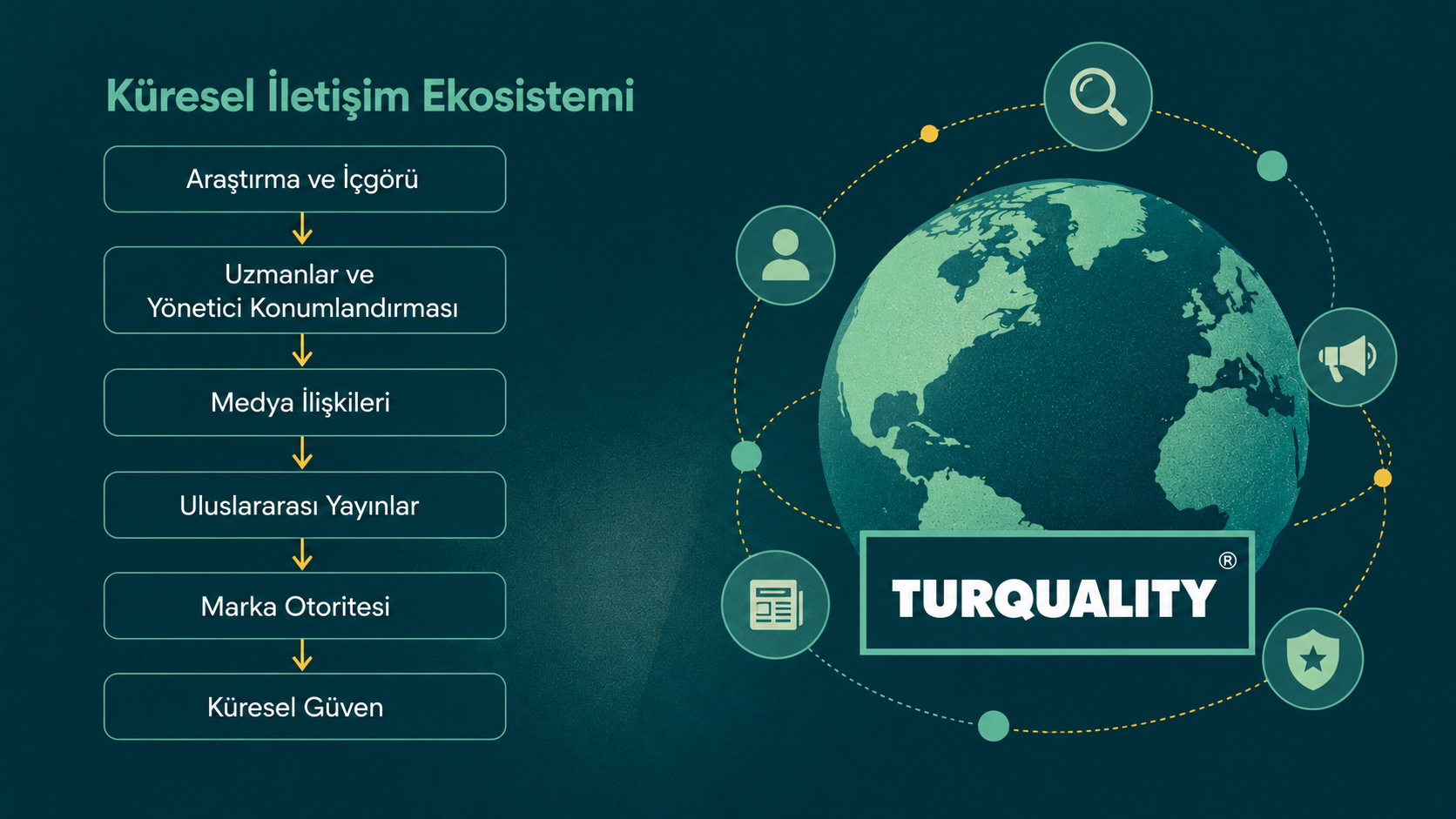
The most important feature of this structure is that each step feeds into the next. Communication activities do not proceed independently; they are planned under a single strategy. Thus, long-term brand value is created instead of short-term visibility.
Notice
This content has been prepared for general information purposes only. The information provided herein does not constitute support eligibility, scope of support, or payment guarantees on behalf of any public institution. Assessments regarding the TURQUALITY® program may vary based on the brand's program status, current legislation, and the review of authorized institutions.